Showing posts with label Chinese. Show all posts

Friday, June 17, 2011

Fusion Pork Chops


I had 5 ingredients that I needed to work with for dinner and my head hurt just trying to figure out what to do with them all. I had on-the-bone pork chops, long beans, mushrooms, quail eggs and sweet potatoes. At first, I wanted to bake the chops with the sweet potatoes but I realized that by doing that, the flavors would be really bold and potatoes and pork would make a meal leaving me with 3 remaining ingredients that were very light in flavor. So instead, inspired by Vietnamese-styled grilled chops with Asian 5-Spice, I marinated the chops in the special spice mix, along with some soy sauce, black pepper, sesame oil and sugar and grilled those babies up.
To serve along side the pork chops, I sauteed the long beans and mushrooms with some seasonings and reserved a few stalks to form "nests" for my soft-boiled quail eggs. I also whipped up some sweet potato mash, making sure to keep it sweet and creamy to counter against the bold and tangy balsamic-soy reduction that I made to bond everything together.
The concept of my dish presentation is to have the "nest" and egg on a cliff, whereas the pork chop served as the cliff levered by the mash and stir-fry. The concept serves as a memorial to a Blue Jay that we found, dead, in our back yard.


Saturday, June 4, 2011

Roasted Grey Mullet Congee


This weekend totally sucked, the sky has been all gloomy, cold and rainy. My mom got sick and I wasn't feeling good either so I decided to make a dish that was an absolute must for sucky days such as this: congee.
Congee is a comfort food made from simmering rice in water until a semi-thin porridge-like consistency is achieved. There are many variations of congee and my variation was a fish congee, using chunks of roasted grey mullet, ginger and scallions. I scaled and gutted a grey mullet, making sure to keep the delicious fat cushioning the fat. I placed the fish and the fat on some tin foil, scored the flesh and seasoned with some olive oil, salt and pepper. Baked the whole thing in a 450 F oven for approx. 20-25 minutes while I brought a pot of water to a boil and simmered around 3/4 to 1 cup of long-grain Jasmine rice, slightly toasted beforehand. Once the rice has broken up and the porridge becomes thick, I added my desired amount of thinly sliced fresh ginger and seasoned lightly with salt and pepper to taste. I left the pot on low heat while I went to de-bone the fish into meaty chunks. If you don't want to go through the process of de-boning an entire cooked fish, you can cook up some fillets (sole, cod, whatever you want) but I personally like to cook a whole fish cause all the juices and flavor are further enhanced. On very low heat, I added the grey mullet meat, gently stirred and added 1 tbsp of fish sauce to boost the flavor of fish in the soup. Adjust seasoning if necessary. Serve hot with sliced scallions for a nice hot meal on an ugly cold day.

For my own vegetarian twist, I made the same rice soup base and added around 1 cup sauteed Cremini mushrooms. I sauteed the mushrooms separately in a small skillet with some shallots and 1-2 tsp of Kikkoman soy sauce. The reason why I used Kikkoman instead of regular soy sauce is because Kikkoman is light to the palette and it does not give a sour-like after taste once added to the soup. Another alternative of Kikkoman is Maggi Seasoning Sauce. I seasoned the soup with salt and pepper and a bit of mushroom seasoning powder. (Sorry, I didn't take any pics...)


Friday, April 29, 2011

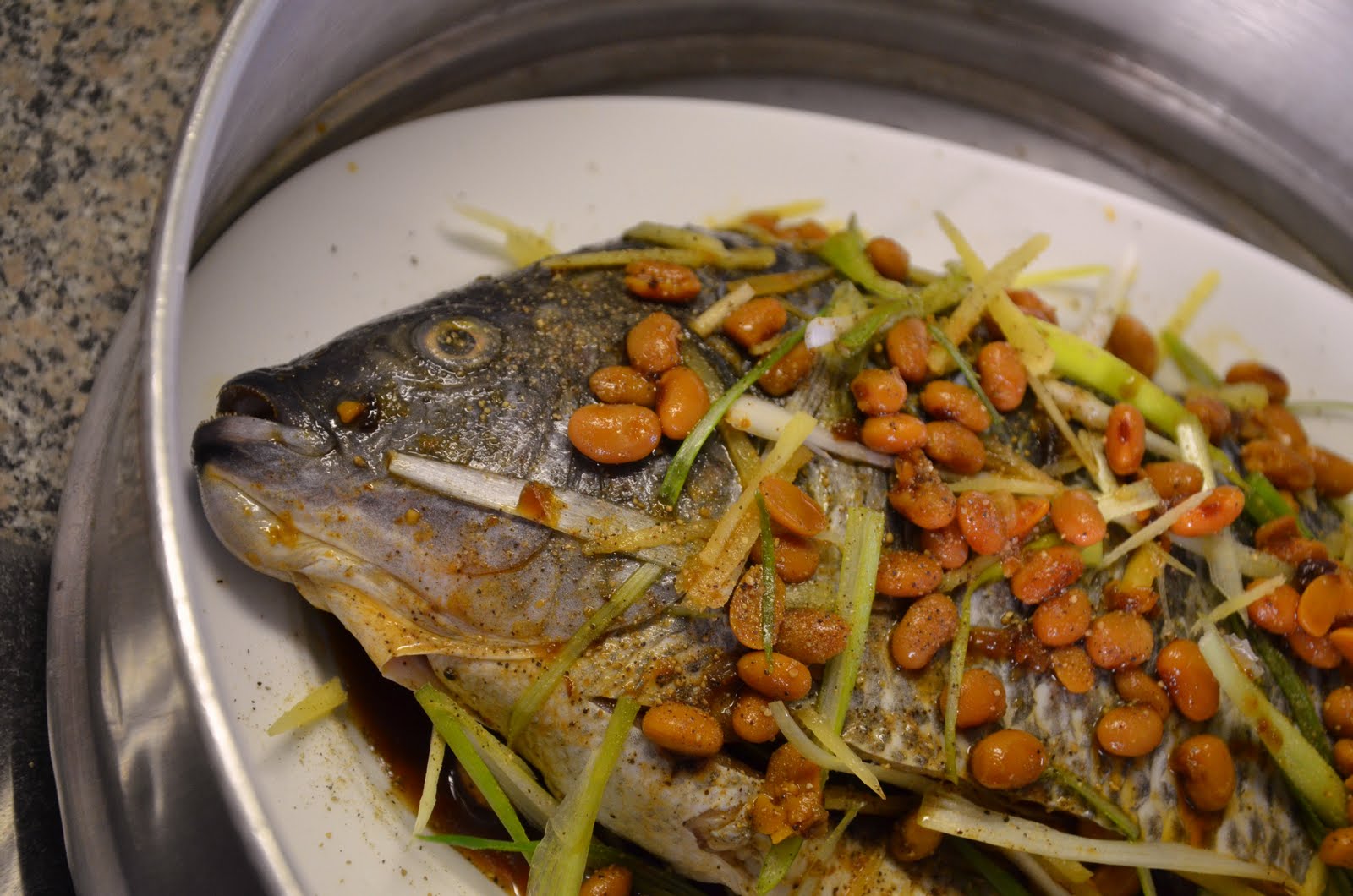
Steamed Tilapia with Black Bean Sauce

I absolutely love cooking with fish and seafood because it is very fast and easy to prepare. As bonus, this Tilapia came gutted and scaled so preparation was even easier (I made sure to rinse it in cold water and removed the coagulated  blood along bones inside the fish to remove the fishy stench, as well as the fins and part of the tail). The sauce was very easy to do, just a  few tablespoons of sweet fermented black beans, soy sauce, brown sugar, and sesame oil-all to your taste really. Before pouring the sauce on the fish, I stabbed the poor thing a couple times on each side with a small pointed knife then sparingly rubbed the fish with salt and pepper, outside and inside. I added sliced green onions and ginger into it's gill cover and it's stomach to further remove the strong fishy odor, and the remaining I placed on top. Spoon the sauce over and inside the Tilapia, shake on some ground pepper and steam over high heat for 20-22 minutes. And Voila, serve with hot rice and you are set!!


Monday, March 7, 2011

Pan-Fried Tofu with Woodears and Gai Lan


I have a confession to make; I dislike cooking with tofu so I rarely do. Strange for a vegetarian, no? Thus after making the homemade extra firm tofu and getting tired of eating it with soy sauce or salt n' pepper, I stored the remaining chunks in the fridge...and I had no idea what to do with it. Usually with my store bought traditional tofu, I make miso soup or eat it in hot pot. That's as far as my imagination goes with tofu. Being that the tofu I made was extra firm, I was faced with an even bigger lack of imagination. Fortunately, my mom enjoys cooking with tofu. She deep-fries and pan-fries, and boils or stews, or mushes the tofu to make savory pies and spring roll fillings. Her skills with tofu completely surpasses mine (clearly). Today, she sliced the chunks of tofu I stored into small, rectangular pieces and pan fried them with garlic then tossed it with blanched gai lan and woodear mushrooms. Wood ear mushrooms have a very crisp texture and is one of my favorite kinds of edible fungi. It's name is derived from how it grows out of trees or decaying logs, resembling ears in the wood. This vegetarian creation is so full of flavor and the tofu's crispy golden exterior was fabulous! Brava, Mom!

1-2 bunches of gai lan, cut into bite sized portions,washed and then blanched
2-3 rehydrated woodears, cleaned and cut into bite size  portions
1 cup extra firm tofu, sliced into rectangles or cubes
3 tsp minced garlic
5 tbsp oil or butter
2 tsp mushroom granules
3 tsp soy sauce
2 tsp sesame oil (opt.)
salt and pepper to taste

Heat oil in a skillet and brown garlic. Add in tofu slices, browning each side to desired crispness.
Add in woodears and gently mix. Add in gai lan and remaining ingredients, gently mix on medium to low heat until all the flavours are infused and to your liking.
Serve with steamed rice and enjoy!!


Saturday, February 26, 2011

Swirly Taro Bread!


I decided to try making these today because I had a chunk of taro sitting on my counter since Monday and it was beginning to bug me. It's a sweet bread with a sweet taro filling. Taro is a starchy root with a strong aroma and very bland taste. I made a sweet filling out of the it and rolled it up into loaves with some bread dough. The bread dough is the same dough I use to make Sweet Bread Buns. Taro is just boiled and mashed with sugar (to liking), about a cup of coconut gratings, 3 tbsp heavy cream and some red and blue food coloring for extra purple-ness (I'm going to use purple yam next time for natural color and sweetness).


Before Proofing 2nd time

Monday, February 7, 2011

Lunar New Years (Vietnamese Customs)


So Lunar New Years has just passed but most Vietnamese households are still celebrating (such as mine lol).
In preparation for this huge celebration, my mom and I made traditional Vietnamese Glutinous Rice cakes (square, prisms, and log-shaped ones). Along with the traditional use of white sticky rice, my mom also used black glutinous rice, which gives a twist in color and in taste. Every New Years, my mom and basically the rest of the family set out to make these delectable cakes, a tradition that has been passed down throughout the generations of the Vietnamese people. A (variation of the) folk tale explains the origins of these rice cakes, and how they represented the Earth and the Heavens:
"There once was a King who was in constant pressure to choose an heir out of his several sons. A few weeks before the celebration of the Lunar New Year, he set up a contest for the young princes; their task was to individually prepare a special dish that is unique and delectable for the king to taste and which would make a fine offering to the ancestors. If the dish is successful and passes judgment, that respective prince will be the next heir. So thus, the princes split throughout the vast kingdom, in search of rare and exotic ingredients to prepare their dish. The youngest of the princes, stayed in the city. The Young Prince did not have as much wealth as his older brothers nor did he have any idea what to prepare because most of what he could think of did not seem unique or fitting for a king. The night before the contest, he decided to forfeit and not attend the taste testing. However, as he slept that night, a magical wise man came into his dreams and instructed him to make two different kinds of cakes made from glutinous rice. One would be in a square shape, wrapped in banana leaves with fillings of savoury mung bean paste and slices of fatty pork. This rice cake, banh chung, would be symbolic to the green rice patties fields found throughout Vietnam, thus representing Earth. The second cake, banh day, which is made from glutinous rice powder, is shaped into thick round patties. The whiteness of these cakes and it's blandness represent purity and the round shape represents how vast and full Heaven is. The magical wise man guaranteed that these cakes will impress the King and the court. The Young Prince arose from his sleep and quickly got to work that very night.
The variety of rice cakes
The next morning, the King and his court assembled and began the taste testings. His many sons presented him with many rare, unique and impressive dishes such as shark fin soup, tortoise stew, and etc. However, none of the dishes could pass the King's approval for they were rare and impressive but they were too luxurious, something the King have grown accustomed to, therefore it was not unique. The last dish was tasted but the Young Prince had not yet arrived. The older Princes jeered and protesting, appealing for the King to go ahead and choose a successor without the Young Prince, as they thought he had probably forfeited. Just as the King was about to give in, the Young Prince arrived, black bangs under his eyes for the lack of sleep (the rice cakes take from 5-12 hours to cook). The court was silent as the Young Prince knelt before his father, and offered his two simple dishes. The Older Princes took one look at his platter and jeered and snickered, muttering among themselves at how ridiculous and stupid the Young Prince is for offering such a simple and common dish. The King, who was also skeptical, asked the Young Prince to explain his dish and its contents. The Young Prince explained the ingredients and the symbolic meanings of each rice cake. The King nodded and gestured the prince towards him for the taste test. With one bite, the King smiled as the aroma and taste of the sticky rice embraced him, along with the savouriness of the fatty pork and the smoothness of the mung bean filling. The rice patties where eaten with a slice of Vietnamese Sausage, which added to the simplicity of the patty. The King proclaimed that The Young Prince was the winner and to honor such a thoughtful and symbolic dish, banh chung and banh day were to be part of the offerings to ancestors for every Lunar New Year to come."

Black Sticky Rice Banh Tet
The square cake has been "re-modeled" into a different shape in Southern Vietnam (the folk tale happened between Northern and Central Vietnam). Southern Vietnamese use the same ingredients to make a variation of the original cake; the shape is log-like and sometimes black eyed-peas are added to the glutinous rice (called "banh tet"). My mom makes her own variation by using black glutinous rice or "velvet" sweet rice in her sticky rice mix, which is mixed with coconut cream for extra flavor and aroma. She also makes a vegetarian variation for me, which she uses raw cashews as my source of protein, along with the mung bean filling (no photos). I love cashews.


Other offerings for ancestors include a platter of fruit that contains a soursop, a coconut, a papaya and mangoes. According to tradition, each fruit represents a slang used as a word of prayer for abundance in the coming new year.

There are a lot of special dishes during the New Year for us. Another main dish is Braised Pork with Eggs. It's basically fatty pork, cut into HUGE chunks, and braised in mixture of coconut juice, sugar and fish sauce, along with hard boiled eggs until all has a caramelized color and the pork can easily be pulled into threads (kinda like pulled pork). The traditional method of cooking this dish is on a stove for several hours but since we are more advanced here, we used a slow-cooker (or crock pot) for it. The meat doesn't dry out and stays yummeh! The pork threads are rolled with pickled bean sprouts in rice paper and is dipped into the braise liquid. it use to be my favourite dish before I became a vegetarian. But I also had my own vegetarian braised pork and eggs (I found some veggie pork chunks at an asian supermarket and the meat had layers of "fat" (made from konnyaku starch). It was sooo yummeh!

Veggie braised Pork and Egg with rice paper and veggies
Veggie Braised Pork (close-up)


Braised Pork and Egg


Pickled Veggies

And of course, the best part after stuffing our faces out was the lucky money!! And with that money, GAMBLING!! har har har!!
This year seems like it will be awesome because my celebratory days were fantastico!

(I know the lucky envelope is yellow, live with it. It was cute.)


Sunday, September 5, 2010

Vegetarian Dim Sum

From top left, clock wise: Shrimp Dumplings, Sticky Rice and Pork Dumplings
When I was still an omnivore, I LOVED Dim Sum. I was a Dim Sum psycho. For those who don't know what "Dim Sum" is, it is a way of eating originated in China, where small portions of dishes are pushed on trolleys to your table and you choose what you want to eat, while drinking tea and conversing with family or friends. The usual time for Dim Sum starts from early morning till a little pass noon, so basically brunch. In simpler terms, it's basically a Chinese buffet brunch that comes to your table. Dishes include steamed buns and dumplings as well as deep fried goodness. For more information visit Wikipedia for all your inquiries.
Shrimp Dumpling
So a couple days ago I went to my local Vegetarian Warehouse (where they sell pre-made veggie goodness and are frozen for your convenience) and found out that they had vegetarian dim sum. I was soooo stoked! They had veggie shrimp dumplings and pork dumplings as well as BBQ pork buns and sticky rice. Since being a vegetarian, it has been difficult to go and enjoy dim sum with my family because the choices for vegetarians are limited. I usually settle for onions cakes and desserts because most or all of the options include meat or seafood. So, after this discovery, I bought a package each of the dumplings and the sticky rice as a trial since I wasn't sure I'd like it. So, last night, for dinner, I steamed up these delectables and indulged myself.

Sticky Rice
Though the appearance of the food was satisfying, I wasn't completely satisfied with the way it tasted. The sticky rice filling was a tad bland. The shrimp dumpling did not have veggie shrimp and the pork dumplings only had turnips, carrots and mushrooms, lacking the protein. My over all disappointment was the fact that the aroma and taste of roasted sesame oil was no where to be found or hinted since it is the vital flavor enhancement in all dim sum dishes. I would probs rate this a 3/5 because of the good shrimp dumpling shell and the presentation, but other than that, they can improve on taste. I might have to make my own again....


Pork Dumplings